The latest segment of the Science Friday podcast, with Ira Flatow, featured Dr. Eric Topol, Scripps Research Translational Institute, professor of molecular medicine, based in La Jolla, California. [Translational research seeks to translate basic science discoveries more quickly and efficiently into practice].
He recounted how AI has used chest X-Rays for a surprising purpose for which they were not intended – to detect early signs of heart disease.
“The fact that there are over 70 million chest X-rays in the United States each year alone– it’s incredible,” Dr. Topol said. “So there’s all this free added information in those chest X-rays that could help us because most people don’t know their cardiovascular risk. And that’s important, especially for determining whether a person should take a statin, and whether it should be an intensive statin type of medication and dosage.”
Topol recounted: “…we can tell from other studies using the chest X-ray for this opportunistic detection that it can pick up the calcium score– what people can undergo a CT scan to see how much calcium they have in their coronary arteries. But that can also be derived from a chest X-ray, and that is an indicator of risk. Also, the chest X-ray can through AI determine the heart strength– the so-called ejection fraction. So it’s picking up a bunch of things, as seen in other studies, that are very predictive of a person’s risk. And it must be the composite of these things. But we really don’t know because, although the study really was extraordinary, it didn’t do enough as far as the explainability side of things.”
AI also proved able to diagnose diabetes from X-Rays. How? “It basically did this so-called occlusion, or masking, where it would look at the chest X-ray and block out various regions to find out what was the source of the information that we can’t see. And it turned out it picked up the fat pads in the chest that was providing this diabetes possible diagnosis.”
AI is exceptionally good at processing a huge mass of data, e.g. 70 million X-Rays, scanning every small detail in each, and then reaching conclusions that human eyes miss. Heart disease is the number one cause of death in the world. Perhaps some of those 70 million people X-rayed in the US will owe their lives and their health to Dr. AI.
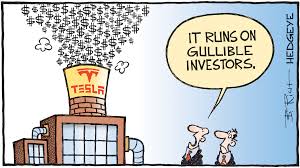
Consider Tesla, Elon Musk’s electric-car baby. In 2010 the market value of its shares was a paltry $2.52 billion. On November 6, 2021, in the midst of a pandemic, Tesla’s shares were worth a staggering $1.23 trillion, at their peak. Today? Tesla is worth less than half that: $554 b.
Before we discuss the key role China has played in Tesla’s growth, here are a few more numbers. Despite the sharp fall in value, Tesla is today worth more than the shares of Ford ($54 b.), GM ($51 b.), Toyota ($332 b.), and Build Your Dream ($81.6 b.). taken together.
In the New York Times “The Daily” podcast, Tesla’s romance with China is told in detail. Here is the story.
In 2017 Tesla was in trouble. Its factory in Fremont, CA., was struggling to produce cars. Musk mounted a massive lobbying campaign, that got a key piece of legislation through the California legislature, under then-Gov. Jerry Brown. Gas-guzzling car makers in California had to pay billions of dollars to Tesla’s “green” cars, based on environmental ‘credits’. Tesla got billions, at a time when Tesla was desperately starved for cash.
But that was just a Band Aid on a deep wound.
China to the rescue. Musk negotiated a deal with China, to build a huge car plant in Shanghai. (The then-mayor of Shanghai is now China’s #2, after Xi Jin Ping). That plant is a paragon of Chinese efficiency. Working 24/7, three shifts daily, it makes a million cars a year. But better than that – Musk persuaded the Chinese government to pay Tesla ‘credits’ from conventional Chinese car makers, just like in California! The State of California closed Tesla’s Fremont plant for two months during the pandemic. China? Tesla’s Shanghai plant closed for two weeks only, even when China locked down huge cities for long months.
China saved Tesla.
Why? Why would China rescue Tesla?
So, here are a few more numbers. Bear with me.
China produces yearly 6 million electric vehicles, soon to rise to 8.77 million. Its EV’s are not quite as sleek and sophisticated as Tesla’s, but they have longer battery range and are much cheaper. BYD has adopted a model pioneered by Henry Ford – vertical integration. BYD produces lithium from mines, electric batteries, basically everything their cars need. BYD swallows every renminbi of profit generated by EV’s and so, can charge much less.
Many of the workers and managers who cut their teeth on the Tesla Shanghai plant now work for Chinese EV makers. In short – China used Tesla to shortcut its EV industry development, leaping ahead while using the California credit system to incentivize its gasoline-car makers to make the shift to EV’s.
And Tesla? The mercuric Elon Musk dabbles in social media, space rockets, colonizing Mars — and supports free-market conservative politics, even though his business is alive because of Calfornia state govt. money. It appears that he has lost interest in Tesla.
In my country, Israel, Chinese EV’s have surged. Press reports note: “Chinese automakers, particularly BYD and Geely, have made remarkable strides in Israel’s automotive market. BYD’s surge from fourth place in 2022 to the top in 2023 indicates the growing acceptance of Chinese brands.”
My mother, Sally Malt, lived to 105. She was sound of mind to the end. She had an exercise machine that she used without fail every day — a treadmill with handles for upper body exercise.
When I used to visit her, I would watch her work out – and then do my own workout. And I follow her model. I work out in the Technion fitness room, focusing on abs and upper body and legs, and do a 3 km. walk regularly down and up a steep hill.
Dana Smith, writing in the New York Times, explains why exercise for seniors can be important for the health of their brains. Here is what she writes: *
* NYT. How Exercise Strengthens Your Brain. April 2, 2024.
“Physical activity improves cognitive and mental health in all sorts of ways. Here’s why, and how to reap the benefits.
“Exercise offers short-term boosts in cognition. Studies show that immediately after a bout of physical activity, people perform better on tests of working memory and other executive functions. This may be in part because movement increases the release of neurotransmitters in the brain, most notably epinephrine and norepinephrine.
The neurotransmitters dopamine and serotonin are also released with exercise, which is thought to be a main reason people often feel so good after going for a run or a long bike ride.
“The brain benefits really start to emerge, though, when we work out consistently over time. Studies show that people who work out several times a week have higher cognitive test scores, on average, than people who are more sedentary. Other research has found that a person’s cognition tends to improve after participating in a new aerobic exercise program for several months.
“Perhaps most remarkable, exercise offers protection against neurodegenerative diseases. “Physical activity is one of the health behaviors that’s shown to be the most beneficial for cognitive function and reducing risk of Alzheimer’s and dementia,” said Michelle Voss, an associate professor of psychological and brain sciences at the University of Iowa.
“How does exercise do all that?
“It starts with the muscles. When we work out, they release molecules that travel through the blood up to the brain. Some, like a hormone called irisin, have “neuroprotective” qualities and have been shown to be linked to the cognitive health benefits of exercise, said Christiane Wrann, an associate professor of medicine at Massachusetts General Hospital and Harvard Medical School who studies irisin. (Dr. Wrann is also a consultant for a pharmaceutical company, Aevum Therapeutics, hoping to harness irisin’s effects into a drug.)
“Good blood flow is essential to obtain the benefits of physical activity. And conveniently, exercise improves circulation and stimulates the growth of new blood vessels in the brain. “It’s not just that there’s increased blood flow,” Dr. Voss said. “It’s that there’s a greater chance, then, for signaling molecules that are coming from the muscle to get delivered to the brain.”
“ Once these signals are in the brain, other chemicals are released locally. The star of the show is a hormone called brain-derived neurotrophic factor, or B.D.N.F., that is essential for neuron health and creating new connections — called synapses — between neurons. “It’s like a fertilizer for brain cells to recover from damage,” Dr. Voss said. “And also for synapses on nerve cells to connect with each other and sustain those connections.”
“A greater number of blood vessels and connections between neurons can actually increase the size of different brain areas. This effect is especially noticeable in older adults because it can offset the loss of brain volume that happens with age. The hippocampus, an area important for memory and mood, is particularly affected. “We know that it shrinks with age,” Dr. Roig said. “And we know that if we exercise regularly, we can prevent this decline.”
“Exercise’s effect on the hippocampus may be one way it helps protect against Alzheimer’s disease, which is associated with significant changes to that part of the brain. The same goes for depression; the hippocampus is smaller in people who are depressed, and effective treatments for depression, including medications and exercise, increase the size of the region.”
It is a rare event when the head of the CIA publishes a long article. When it happens – it is worth paying close attention. Because as head of the CIA, he knows a great deal more than you and I.
William Burns has published a long thoughtful article in the March-April issue of Foreign Affairs.* It is about how he is shifting the CIA’s abilities and activities, to meet the challenge of the Russia-China-Iran axis of evil. But it is also about Russia’s massive failure in Ukraine.
Here is the essence, paraphrased.
The extensive casualties and material losses suffered by the Russian military are a testament to the miscalculations that underpinned the invasion. Putin’s initial strategy, predicated on a quick and decisive victory, has unraveled, revealing the limitations of Russian military power and the effectiveness of Ukrainian tactics, supported by Western military aid. The destruction of a significant portion of Russia’s pre-war tank inventory and the exposure of its flawed military modernization efforts underscore the strategic and tactical failures of the Russian command.
Economically, Russia faces a dire future, with long-term repercussions from the war exacerbating its status as a subordinate economic partner to China. The strategic blunders of Putin have not only inflicted immediate economic damage but have also compelled Russia into a dependent relationship with China, undermining its global standing. The strengthening of NATO, contrary to Putin’s intentions, marks another strategic miscalculation, as the alliance has emerged more cohesive and determined in the face of Russian aggression.
Internally, the war has eroded Putin’s authority, with the rebellion led by Yevgeny Prigozhin exposing the cracks within the Russian political facade. This internal turmoil raises questions about Putin’s grip on power and the sustainability of his authoritarian regime. The challenges facing Putin domestically are compounded by the resilience of the Ukrainian people and the international community’s support for Ukraine, challenging the narrative of Russian invincibility.
In this context, Putin’s reliance on defense production and alliances with China, Iran, and North Korea reflects a desperate bid to regain the initiative. However, this strategy overlooks the enduring resolve of Ukraine and its allies, underestimating the costs of continued aggression and the international resolve to support Ukraine’s sovereignty.
– – – – – – –
A New York Times report states that Russia has received crucial supplies of weapons from North Korea. Add to this the Iranian drones. Russia is now a vassal state of China, crucially dependent on China’s purchase of Russian oil.
Would you invest in a country whose future is crucially dependent on China, North Korea and Iran? Putin has no future. Russia’s future is bleak.
* William Burns. Spycraft and Statecraft: Transforming the CIA for an age of competition. Foreign Affairs March-April 2024.
Daniel Kahneman passed away in Princeton, NJ, yesterday (Wednesday), three weeks after his birthday. He was 90 years old. In 2002 Kahneman, an Israeli psychologist, won the Nobel Prize for Economics, together with Vernon Smith.
And therein, lies a story. How in the world can a psychologist win a Nobel Prize in a discipline distant from his own, as day is distant from night?
In 2003, I wrote a review article on Kahneman (and his sidekick Amos Tversky, who died of cancer in 1995 – otherwise, he would have shared the Nobel with Kahneman).
I wrote: “There are two ways to research how people make judgments under uncertainty. One is mathematics. Define a minimum set of axioms necessary to obtain analytical solutions for equilibrium. Examine that equilibrium’s efficiency, optimality, stability and uniqueness.” For 150 years, this is how economists did research, largely, creating La-La Land theories and ‘verifying’ them by crunching numbers.
But there is another way. “A second approach is behavioral. Offer people (surgeons, statisticians, psychologists, ordinary people) a series of pair choices. Would you prefer—
A. 50% chance to win a 3-week tour of England, France, and Italy or B. (100% certain) 1-week tour of England. Observe their behavior carefully and generalize.”
Surprise! Turns out that people are more complex in their behavior (toward risk, toward EVERYthing!) than economists’ math models. It took two Israeli psychologists, who amazingly published their keystone 1979 paper in the leading theoretical, mathematical journal, Econometrica AND SPOKE TO ECONOMISTS IN THEIR LANGUAGE, BUT SINGING A COMPLETELY DIFFERENT TUNE! They presented their psychological theory of behavior toward risk, “Prospect Theory”, as a mathematical model – with behavioral evidence.
Perhaps Kahneman’s most influential book is 2011 Thinking, Fast and Slow. The book’s main thesis is that we have two modes of thought: “System 1”, fast, instinctive and emotional; “System 2”, slower, more deliberative, and more logical. A lot of what we do is driven by System 1 and the emotional, limbic part of our brain. (That’s how I chose, at age 18, to study Economics. System 1. Bad move! ) .
Economics today has changed its DNA, from mathematics to behavior. In large part, thanks to Kahneman.
If you have patience for a few hundred more words, read below how Kahneman gained crucial insights about behavior, from Israeli pilots:
Daniel Kahneman gave a lecture to Israeli fighter pilots about effective training practices. During his talk, Kahneman discussed the well-supported concept that rewarding good performance is more effective than punishing poor performance. An incredulous senior Air Force instructor confronted Kahneman and said that criticising his trainee pilots for poor execution of aerial manoeuvers worked. How did he know? The instructor had noticed that when he criticized trainees after they poorly executed a manoeuver, they almost always improved on their next attempt. Sharp criticism works.
Kahneman drew a chalk target on the floor, had the officers turn their backs to the target and try to hit the target with two no-look coin throws. Officers who were far from the target on their first throw improved on the second throw; officers who were close to the target on their first throw did worse on their second throw.
Kahneman showed how we conflate ‘effective feedback’—either positive or negative—with regression to the mean. Did poorly on the maneuver? Chances are, the next try will be better. Did great? Maybe next time will be less great. Behavior tends to the mean.
I often wonder how different the world might be today, if economists had not taken a wrong turn, from Adam Smith in 1776, through Afred Marshall in 1880, to large-scale black-box econometric models in the 1960s. And just did a simple pivot, as Kahneman and Tversky did — get out of your office and study real people.
Rest in peace, Daniel Kahneman. You can say what few others can – as a researcher, your work really did change the world and changed the way we think and act and choose. For the better.
What in the world happens to billionaires, after they begin as entrepreneurs out to change the world for the better, and end up ruining the world, for the worse?
Mark Zuckerberg started at Harvard, with an idea to produce an online class yearbook, in place of the old-fashioned print book. It was a success – other universities wanted to copy it..and the result was Facebook (Meta), market cap $1.26 trillion! Zuckerberg is worth $177 billion.
According to a lawsuit filed by New York State, and other state governments: “Kids and teenagers are suffering from record levels of poor mental health, and social media companies like Meta are to blame. Meta has profited from children’s pain by intentionally designing its platforms with manipulative features that make children addicted to their platforms while lowering their self-esteem.”
The worst part is, Facebook insider whistleblowers say Facebook has research that shows they know they are deeply harming kids. But – hey, bottom line, fellas. Capitalism. We have shareholders, you know.
Zuckerberg?
Elon Musk, against the odds, built a massive global electric car company, now worth $556 billion. His personal wealth: $194 billion. Musk has pioneered SpaceX, and brain implants for paraplegics. News reports now claim: Long considered non-identifiable ideologically, Musk’s politics are now hardline right wing as he uses his platform (now called X) to stoke the themes cherished by Fox News, conservative talk radio and far right movements across the West.
Jeff Yass, a pauper, worth only $27.5 billion, is a cofounder of Susquehanna, a huge global Wall St. trading firm. He first became a pro gambler, then began trading on the Philadelphia Stock Exchange in 1981 backed by billionaire Israel Englander. In 1987, he cofounded Susquehanna with a handful of partners; it’s now a giant in options trading and making markets, with 2,000 employees worldwide.
Yass funded an Israeli right-wing think tank, Kohelet, which powered and funded the far-right Netanyahu government’s anti-democratic initiative, causing 10 months of wild street protests, culminating in the October 7 massacre by Hamas, perhaps tempted by fractious Israeli politics. Yass was an early investor in TikTok, a social medium that originated in China, that has caused Israel massive harm and damaged the lives of young people in the US and elsewhere. (Trump originally supported Biden Administration efforts to make Bytedance divest TikTok – then did a sharp U-turn when Yass, a big Trump supporter and donor, whispered in his ear).
The list is endless. Massive wealth seems to push good people to the right and far right, where they use their billions to do huge damage.
We need an inheritance tax, so that the billionaires do not bequeath their malice and money to the young generation. Laurene Powell Jobs, Steve Jobs’ widow, told NPR she intends to give away her wealth, rather than bequeath it, and already has donated billions.
Power corrupts, the saying goes. Money corrupts even more. Warren Buffett organized a large group of billionaires who committed to giving away their wealth. Buffett, the Omaha wizard, never lost his folksy demeanor or common-people values. But many other billionaires have lost their way.
Here is the story of how a man, leading polls in the Presidential race, who may become President of the US in November, has engineered a legal swindle, that may cost unwitting innocents much cash, because he needs money to pay his mounting legal bills and bail bonds.
Here’s how a man running for President uses legal means to turn $3.7 million into $3.5 billion [“Trump Media booked $3.7 million in revenue in the first nine months of 2023 and “expects to incur significant losses into the foreseeable future,” according to a regulatory filing. Unless it can rapidly boost its revenue or turn a profit, it could have difficulty maintaining its lofty valuation, experts said.]. This man, Trump, will likely have between 75 and 80 million Americans who vote for him in November. Really.
This is from CBS News: (and you could not make it up if you tried):
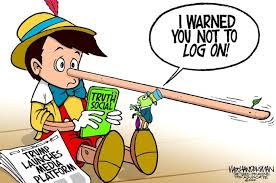
“Former President Donald Trump could soon receive a windfall valued as much as $3.5 billion, with shareholders of a publicly traded funding partner voting Friday on whether to merge with his Trump Media & Technology Group. The vote is taking place about one month after the two companies received regulatory approval to proceed with the long-delayed merger. If shareholders of Digital World Acquisition Corp. (DWAC) approve, the businesses could combine soon afterward, putting the former president’s Truth Social social media platform on the stock market. Trump created Truth Social as a conservative-focused social media service after he was banned from Twitter, now known as X, and other platforms following the January 6th riot.”
This is a back-door Initial Public Offering of stock, bypassing the normal tough SEC regulations.
“Digital World is a special purpose acquisition company, or SPAC, a shell company that is created to take a private business public without conducting an initial public offering. The new company would be renamed Trump Media & Technology Group Corp. and trade under the stock ticker DJT, the same letters as Trump’s initials, according to regulatory filings.”
SPACs have long gone out of fashion. Trump is using SPAC to make a quick buck, leveraging his MAGA supporters who will buy anything with the stock ticker DJT (Donald J Trump, get it?).
“Trump stands to make a fortune from the pending deal, given that he would control 78.8 million shares of the newly merged company, or about 58% of the business. Based on DWAC’s current stock price, that stake could be worth as much as $3.5 billion.”
No, Trump can’t flip his stocks and sell them at once. He’s limited by law to hold them for six months. Can he borrow against them? No. “Trump likely won’t be able to use the stock to get a loan, either. That’s because the DWAC regulatory filing states that founding investors can’t sell, lend, donate or encumber their shares for six months after the deal closes.” [a ‘lock-up agreement’].
“It’s possible that Digital World could waive the lock-up agreement before the deal closes. Or, in what some legal experts say would be a more likely path, the new company’s board could decide to alter the lock-up agreement after the deal closes. Such a decision by the new board could open those directors up to legal scrutiny, however. They would need to show they’re doing it to benefit shareholders.”
Look for cynical Wall St. pros to buy shares in the new company, then sell them a day or two later, profiting from the expected enthusiastic, naïve purchases of Trump supporters (it seems they will buy anything, including fabrications, lies, untruths and worthless shares, as long as they have the initials DJT on them). Those supporters will buy high, and in the end, sell low.
Will they blame the MAGA fraud? No. They never do.
Some of DWAC’s shareholders appear to be Trump followers, as one group on Truth Social includes more than 7,850 users who have been communicating about the stock and its prospects. That raises the possibility that DWAC’s shares are currently getting a lift from Trump’s supporters at a time when Trump is moving closer to securing the GOP nomination for president.
That windfall could land in Trump’s lap at a time when his financial pressures are ratcheting up. For one, Trump’s lawyers have said he’s been unable to secure a bond to appeal a judgement of more than $460 million in his civil fraud case. If he can’t pony up the money by March 25, New York state could seize property from Trump to satisfy the ruling.
Trump is also facing hefty legal bills in the other court cases against him, including more than $8.5 million in legal expenses so far in 2024 alone. His political action committees last year spent more than it raised, partly due to almost $50 million in legal fees for the president’s ongoing legal defenses.
But while a $3.5 billion stake in a publicly traded company could help relieve some of those financial pressures, it’s unlikely to immediately help Trump. That’s because he and other big shareholders are subject to a so-called “lock-up” provision that bars him from selling his stock for at least six months.
Here’s what to know.
Why can’t Trump immediately sell his stake in Trump Media?
That’s due to a lock-up provision for major shareholders, according to a DWAC regulatory filing.
Lock-up provisions are a common restriction on Wall Street designed to keep big investors from dumping their shares in a company soon after the company goes public. If they were to occur, such large stock sales could cause a company’s shares to tank.
Legal experts say “encumber” is a powerful word that could prevent Trump from using the stock as collateral to raise cash before six months have elapsed.
Could Trump sell before the lock-up expires?
Could Trump sell his stock after the six months are over?
Yes, but typically major shareholders don’t sell their entire stake in one sale. That’s because such a big transaction could undermine other investors’ faith in the stability of the company as well as flood the market with available shares, potentially leading to a plunge in the company’s share price.
Major stockholders and company founders usually sell their shares in smaller amounts over time to avoid destabilizing the stock price.
Is Trump’s stake really worth $3.5 billion?
That figure is based on the current trading price of DWAC and the number of shares that Trump will own after the merger closes.
But any publicly traded investment comes with risks, including the possibility that the shares could lose value. Once publicly traded, the Trump Media Group could face more scrutiny from a wider pool of investors, who might not see the same value in it as DWAC’s current shareholder base.
“In the short term, if a lot of people say, ‘I don’t really care what it’s worth, I’m just gonna keep buying it, and I’m gonna keep propping it up,’ you can do that for a reasonable period of time,” said Harry Kraemer, a professor specializing mergers and acquisitions at Northwestern University’s Kellogg School of Management. That “almost defies economic logic, but there we are,” he added.
For one, the Trump Media Group’s main asset is Truth Social, which is lagging far behind rival social media platforms such as Facebook, X and Instagram in both users and advertisers. Truth Social is filled with advertisements for faux-medical cures, Trump-themed merchandise and right-wing companies.
“Given the fact that their sales last year were less than $5 million, and they’re losing significant money, it is hard to believe that the long-term economic value of this company could even be as high as $100 million,” Kraemer said. “So talking about billions is absolutely ridiculous from an economic standpoint.”
Again, Trump also faces risks if he sells stock once the lock-up provision is expired. For instance, if he sells a large stake, the value of the stock could decline, which would then lower the value of his remaining shares at a time when he may need more money to pay legal bills or fund his campaign.
“As soon as people know he’s gonna sell the stock, they’re gonna want to sell the stock, and the stock is going to crater,” Kraemer predicted.
Last October, a terrible tragedy unfolded in little Lewiston, Maine. Robert Card, 40-year-old Army reservist and veteran, shot and killed 18 people! Then he committed suicide.
The shooting was especially lethal, because Card was a certified Army firearms instructor.
Why?????
Unlike many such mass shootings (by the way – they are the #1 cause of death now, among children!), this one had a clear explanation. The BBC reported on its website:
“… doctors said on Wednesday that he may have suffered brain injuries during military drills. Card was a long-time instructor at an Army hand grenade training range, according to a statement released by the Concussion Legacy Foundation on Wednesday. During that time he was exposed to “thousands of low-level blasts”, the organization said. Dr Ann McKee from Boston University’s CTE [Chronic Traumatic Encephalopathy] Center, who conducted the study of Card’s brain, said that nerve fibres in Card’s brain showed “significant degeneration… inflammation” and “small blood vessel injury”.“ (CTE is what many retired National Football League players suffer, after repeated blows to the head, even when protected by high-tech helmets).
In a typical training session for West Point cadets, Card would supervise over a thousand cadets, each of whom would throw two grenades on a firing range. One session – 2,000 explosions. Many such sessions – many thousands of explosions.
Card told people he heard voices, that said terrible things about him – that he was a pedophile. Those repeated explosions literally scrambled his brain. The damaged nerve fibers are the ‘wires’ that connect brain cells and transmit messages.
In my army service, in a reserve artillery unit, my job was to scout future placements. I generally was far from the blasts themselves. But what about the gun crews? And what about all the kids who play Pop Warner football? And the football players in college? And in the NFL?
It is time we showed new respect for our delicate brains. If avoidable, we need to guard them from blasts, blows or other harmful things. Robert Card was not to blame. His army service scrambled his brain. How many others suffer from similar damage?
Voyager 1 is a space probe launched by NASA on September 5, 1977, as part of the Voyager program to study the outer Solar System and the interstellar space beyond the Sun’s heliosphere.[1]
It is now 15.2 billion mi. (24.3 billion kms.) from Earth as of January 2024. And it is the most distant human-made object from Earth. Radio messages take 22 hours, 33 minutes and 35.0785 seconds to travel from Voyager 1 and arrive to us – round trip, that’s 45 hours! Say “hi!” to Voyager… and it will respond, “Hawarye?” back two days later.
Voyager was designed to send data for just a few years. But it has lasted… so far, for nearly 47 years! It’s data computer is 1970 technology. I did my Ph.D. on a Princeton mainframe in 1967, using punch cards to feed in data, and received printouts on big rolls of hole-punch paper.
Voyager is suffering from dementia. Yes, space probes, too, get addled brains. The data Voyager is sending back is just… gibberish. NASA engineers have tried turning it off and back on – doesn’t help. Voyager is way to far from the sun to use solar panels – it has nuclear batteries, amazing ones, that have lasted for 47 years. But they too will run out of juice soon.
Voyager, it seems, was built to last. Unlike stuff made to day, which is made to break – so we have to buy more of them. Or made to throw away, because it is too expensive to repair.
From 15 billion miles away, Voyager is sending a message.
Hey, planet. Keep using the old stuff. No, you don’t need iPhone 16, iPhone 12 is perfectly good. (Like mine). Look at me. I’m still (barely) alive. You don’t need to stuff your closet with stuff. You don’t need to respond puppet-like when the fashion gurus say, baggy pants today, tight pants tomorrow. Pink today, beige tomorrow. You don’t need to buy a heavy expensive SUV, just to drive to the corner store.
Thanks Voyager. Who knows? Maybe one day you will bump into an alien life form, maybe they will capture and revive you…and send us back an incredible ‘hello, Earth’. Just don’t say, Take me to your leader. Because…well, we really don’t have one at the moment.









 TIMnovate